The Hitchhiker's Guide to the Galaxy
A small, thin, flexible quadrilateral device with about a hundred flat buttons and a screen measuring four inches square. On its cover are the words DON'T PANIC inscribed in large, friendly letters.
Galactic Publication: The Hitchhiker's Guide to the Galaxy
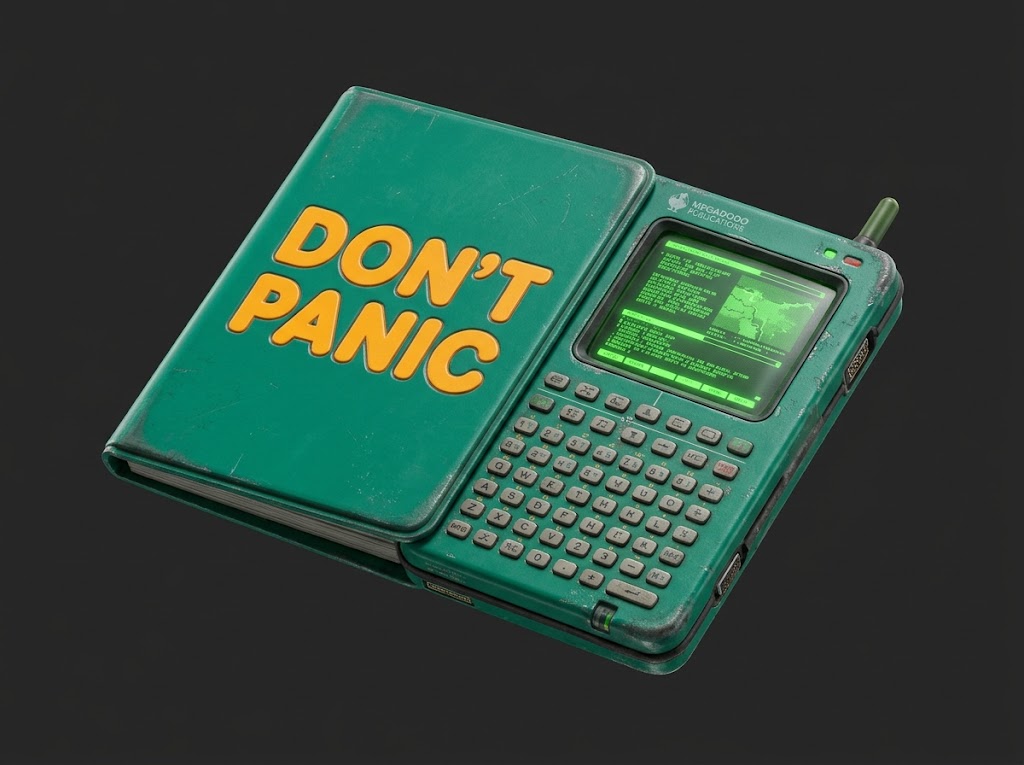
The Hitchhiker's Guide to the Galaxy is an indispensable electronic companion to all those who wish to make sense of life in an infinitely complex, confusing, and thoroughly disorienting Universe. It has long since supplanted the older and vastly more ponderous Encyclopaedia Galactica as the standard repository of all knowledge and wisdom.
Hardware & Micro Sub-Meson Architecture
"He also had a device which looked rather like a largish electronic calculator. This had about a hundred tiny flat press-buttons and a screen about four inches square on which any one of a million 'pages' could be summoned at a moment's notice. It looked insanely complicated, and this was one of the reasons why the snug plastic cover it fitted into had the words DON'T PANIC printed on it in large friendly letters. The other reason was that this device was in fact that most remarkable of all books ever to come out of the great publishing corporations of Ursa Minor — The Hitchhiker's Guide to the Galaxy. The reason why it was published in the form of a micro sub-meson electronic component is that if it were printed in normal book form, an interstellar hitchhiker would require several inconveniently large buildings to carry it around in."
— The Hitchhiker's Guide to the Galaxy, Chapter 3
The Guide resembles a largish electronic calculator housed within a snug plastic cover:
- Display, Index & Voice Playback Controls: Features a screen about three inches by four (or roughly four inches square) and about a hundred tiny flat press-buttons capable of summoning any one of a million "pages" at a moment's notice. Pressing the index button lights up the screen with the index; tapping in a query (such as Vogons) flares the entry title (Vogon Constructor Fleets) in green across the screen; and pressing a large red button at the bottom of the screen causes the words to undulate across the display while the book speaks the entry aloud in a still, quiet, measured voice.
- Micro Sub-Meson Component: Published as a micro sub-meson electronic component rather than a normal printed book, saving interstellar hitchhikers the inconvenience of dragging several large buildings around with them.
- The Cover: Because the device itself looks insanely complicated—and because the galaxy is an alarming place—the snug plastic cover it fits into has the words DON'T PANIC printed on it in large, friendly letters. When Ford Prefect handed the Guide to Arthur Dent inside the Dentrassi galley cabin (where Arthur initially held it as if it were a two-week-dead lark), Arthur turned it over nervously and remarked: "I like the cover. 'Don't Panic.' It's the first helpful or intelligible thing anybody's said to me all day."
- Field Research & The New Revised Edition: Because the Galaxy changes rapidly—for instance, the older edition states under Vogon Constructor Fleets to "forget it" if you want a lift from a Vogon, before the Vogons began employing Dentrassi cooks who happily smuggle hitchhikers aboard—roving field researchers like Ford Prefect continually gather updates for the new revised edition so impoverished hitchhikers can see the marvels of the Universe for less than thirty Altairian dollars a day.
Why The Guide Outsold The Encyclopaedia Galactica
- Cost: It is slightly cheaper (priced at an accessible 42 Triganic Puves).
- Typography: It has the words DON'T PANIC written in large friendly letters on the cover.
- Definitive Inaccuracy: Where it is inaccurate, it is at least definitively inaccurate. In cases of direct discrepancy between the Guide and Reality, reality is cordially invited to reconsider its position.
Compilation History & The Introduction on the Size of Space
The Hitchhiker's Guide to the Galaxy is a very unevenly edited book, having been compiled and recompiled many times over many years and under many different editorships, and containing contributions from countless numbers of travellers and researchers.
The introduction begins with the famous meditation on the sheer vastness of the cosmos:
"Space," it says, "is big. Really big. You just won't believe how vastly, hugely, mindbogglingly big it is. I mean, you may think it's a long way down the road to the chemist's, but that's just peanuts to space. Listen..." and so on.
— The Hitchhiker's Guide to the Galaxy, Chapter 8
After a while the style settles down into practical travel lore and astronomical scale analogies:
- The Bethselamin Lavatory Receipt Warning: Because the fabulously beautiful resort planet Bethselamin is visited by ten billion tourists a year, its authorities are so worried about cumulative planetary erosion that any net imbalance between the amount you eat and the amount you excrete whilst on the planet is surgically removed from your bodyweight when you leave—making it vitally important to get a receipt every time you go to the lavatory there.
- The Reading Peanut & Johannesburg Walnut Analogy: To help the reader's brain deal with interstellar distances without shrinking from the effort, the Guide suggests imagining that you are holding a lungful of air, or that you have a peanut in Reading and a small walnut in Johannesburg (and other such dizzying concepts).
- Light-Speed Benchmarks vs. Hitchhiking Records: At the speed of light ($186,000$ miles per second), it takes eight minutes to travel from the star Sol to the place where Earth used to be, four years more to arrive at Sol's nearest stellar neighbour, Alpha Proxima (Alpha Centauri), and five hundred thousand years to reach the other side of the Galaxy at Damogran. The record for hitchhiking that five-hundred-thousand-light-year distance is just under five years—though you don't get to see much on the way.
- Vacuum Survival & Rescue Odds: The Guide states that if you hold a lungful of air, you can survive in the total vacuum of space for about thirty seconds. However, it goes on to say that what with space being such a mindbogglingly big place, the odds of getting picked up by another ship within those thirty seconds are $2^{276,709}$ to 1 against (two to the power of two hundred and seventy-six thousand seven hundred and nine to one against)—which, by a staggering coincidence, was also the telephone number of the Islington flat where Arthur Dent once attended a party and met Trillian before Zaphod Beeblebrox gatecrashed.
Famous Entry: Earth
Because there are a hundred billion stars in the Galaxy and only a limited amount of space in the Guide's microprocessors—and because no one knew much about the Earth—the previous edition of the Guide contained an entry on Earth hidden at the very bottom of the screen, directly underneath Eccentrica Gallumbits, the triple-breasted whore of Eroticon Six, consisting solely of a single word:
"Harmless."
Following fifteen years of field research on Earth, roaming contributor Ford Prefect transmitted a new entry off to the editor. After the editor trimmed it a bit, Ford admitted with a slightly embarrassed cough to Arthur Dent that the improved entry now read:
"Mostly harmless."
Famous Entry: Smuggling Antarean Parakeet Glands
During the automated missile crisis in orbit above Magrathea (Chapter 17), when Ford Prefect's Guide was hurled across the cabin and smashed violently into a flight console, its automated vocal synthesizer inadvertently began broadcasting instructions to anyone who cared to listen on the trade in Antarean Parakeet Glands:
"The Guide started to explain to anyone who cared to listen about the best ways of smuggling Antarean parakeet glands out of Antares (an Antarean parakeet gland stuck on a small stick is a revolting but much-sought-after cocktail delicacy and very large sums of money are often paid for them by very rich idiots who want to impress other very rich idiots)..."
Famous Entry: The Bowl of Petunias
Following the unshielded Improbability jump in orbit around Magrathea (Chapter 18), the Guide notes the cosmic mystery surrounding the falling Bowl of Petunias:
"Curiously enough, the only thing that went through the mind of the bowl of petunias as it fell was, Oh no, not again. Many people have speculated that if we knew exactly why the bowl of petunias had thought that we would know a lot more about the nature of the Universe than we do now."
Famous Entry: Veet Voojagig & The Biro Disappearance Theory (Chapter 21)
As Arthur Dent discovered while whiling away time on the rim of the Magrathean crater, the Guide is a very unevenly edited book containing many passages that simply seemed to its editors like a good idea at the time:
- The Academic Career: Details the experiences of Veet Voojagig, a quiet young scholar at the University of Maximegalon who studied ancient philology, transformational ethics, and the wave harmonic theory of historical perception.
- The Biro Hypothesis: After an evening drinking Pan Galactic Gargle Blasters with Zaphod Beeblebrox, Voojagig surveyed planetary centers of stationery loss and posited that alongside worlds of humanoids, reptiloids, fishoids, walking treeoids, and super-intelligent shades of the colour blue, there exists a secret planet of biro life forms who slip through microscopic wormholes to lead a leisurely biroid life.
- Limousines and Tax Exile: Voojagig's claim to have worked as a limousine chauffeur for a family of cheap green retractables led to his institutionalization, a bestselling memoir, and eventual tax exile.
- The Asteroid Hermit & Second-Hand Trade: A subsequent expedition to the coordinates found only a tiny asteroid inhabited by a solitary hermit who claimed nothing was true—while banking 60,000 Altairian dollars a year, directly tied to Zaphod Beeblebrox's thriving second-hand biro business.
Field Researcher Protocol
Any traveler possessing a valid copy of the Guide, an Electronic Thumb, and an intact towel is recognized under Interstellar Convention as a bona fide hitchhiker, entitled to hitch free passage aboard commercial freighters, luxury cruisers, and demolition barges throughout the Western Spiral Arm.
Heart of Gold Sales Brochure
A glossy promotional sales brochure discovered on the floor of the Heart of Gold's embarkation area, extolling Infinite Improbability Physics and Genuine People Personalities.
Well That About Wraps It Up For God
Oolon Colluphid's bestselling theological polemic that earned him a small fortune by using the Babel fish proof of the non-existence of God as its central theme—despite most leading theologians claiming the argument is a load of dingo's kidneys.